

Short-term rentals (STRs), including mainstays such as Airbnb and VRBO, captured 9.5% of lodging revenue in Texas equating to $1.54 Billion in the 12 months ending Q1 2026, up 10% over the previous year. In that period, Airbnb accounted for 7.2% of statewide lodging revenue, HomeAway (VRBO) for 0.9%, and other STR platforms made up 1.4%. Hotels are still the preferred lodging option, bringing in 87% of lodging revenue ($14.15 billion) while alternative kinds of lodging such as cabins, condominiums, and RV parks make up the rest (3.5%). Since 2019, statewide STR market share has grown to 264% of its 2019 level, from 3.6% to 9.5% of lodging revenue.
STRs Widen Their Lead in Texas’ Top Metros
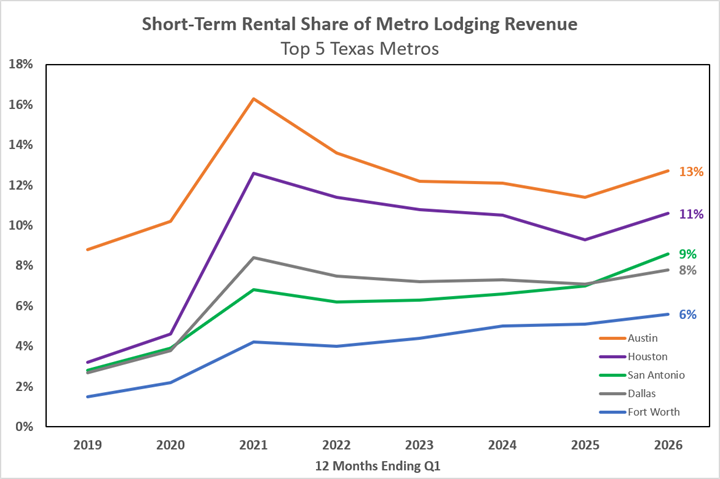
Over the past eight years, STRs have steadily grown their share of the Texas lodging market. Guests seeking minimal contact with others turned to short-term rentals during the pandemic, and STRs have held that ground ever since. In the year ending Q1 2026, STR growth accelerated across the state’s top 5 metros while hotel revenue fell 3.6% over the same period.
Austin leads with STRs capturing 13% of lodging revenue ($287 million), followed by Houston at 11% ($343 million), San Antonio at 9% ($141 million), and Dallas at 8% ($248 million). Fort Worth has the lowest STR share at 6% ($87 million) — consistent with a business-travel-heavy market that favors predictable hotel stays over the leisure and event-driven demand seen in Austin, Houston, and San Antonio.
Coastal Metros Lead the State in STR Market Share
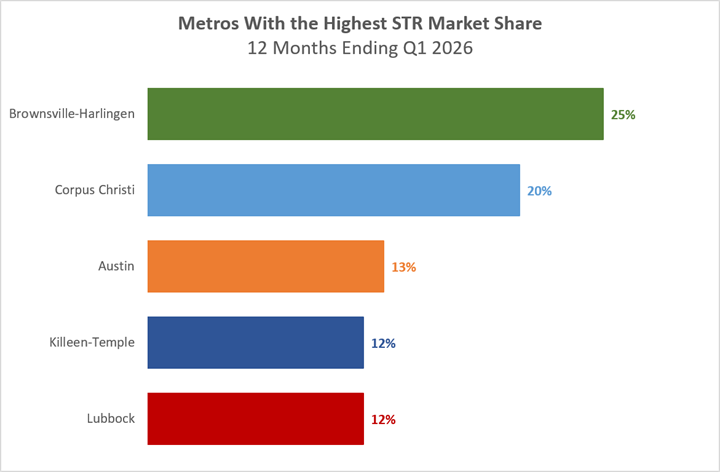
Brownsville-Harlingen posts the highest share of lodging revenue from STRs in the state for the year ending Q1 2026, driven largely by South Padre Island rentals, with Corpus Christi close behind. Both coastal metros draw tourists to beachfront properties that make up a large share of local lodging supply. Austin remains the largest STR market by dollar volume, with Killeen-Temple and Lubbock trailing closely.
Texas has no statewide STR restrictions, so regulation is left to individual cities. Fort Worth bans STRs from all residential districts, Austin and San Antonio cap the number of STR units, Corpus Christi restricts STRs in single-family zoning, and several Galveston neighborhoods prohibit them entirely. Much of this comes down to neighbor impact: in a 2025 Galveston STR community survey of 1,020 respondents, 38% cited noise or nuisance as at least an occasional issue and 35% cited parking problems on their street.
Looking Ahead: Hotels Keep Their Edge as Data Center Demand Grows
STRs have gained ground across Texas, but hotels remain the dominant lodging option statewide. As AI data center construction accelerates in markets with limited hotel supply, existing housing stock offers an easy conversion point to meet sudden demand spikes. Expect metros with fast-growing STR activity to face additional restrictions as cities work to keep residential neighborhoods from operating as de facto commercial lodging. For hotels, a consistent, dependable guest experience remains the strongest differentiator.
About Source Strategies
With over 30 years of Texas hotel performance data, Source Strategies helps clients navigate market volatility and evaluate development decisions. We help you understand your market and how your hotel project may perform through data-driven feasibility studies and performance benchmarking.
Go Deeper on Your Market
Subscribe to the Texas Hotel Performance Factbook to see how the major short-term rental providers are doing in your area. Explore hotel data, benchmark performance, and get ahead of the next regulatory shift in the Texas Hotel Performance Navigator online platform, or call us at (210) 734-3434.